

Jacob Burmeister is four years old. This week, he walked to kindergarten.
For most families, that's an ordinary morning. For Jacob, who lives with recessive dystrophic Epidermolysis Bullosa (RDEB) - a rare genetic condition that causes the skin to blister and tear at the slightest touch - it represents something that wasn't possible before.
Jacob has just become the first Australian to receive beremagene geperpavec (B-VEC), a topical gene therapy approved by the FDA in 2023. His wounds have started to repair. His mobility continues to improve. The treatment was administered at the Royal Children's Hospital Melbourne, with EB Research Partnership Australia (EBRPA) as one of the partners that helped get it there.
EBRPA's Board Chair, Nathan Burmeister, is also Jacob's father.
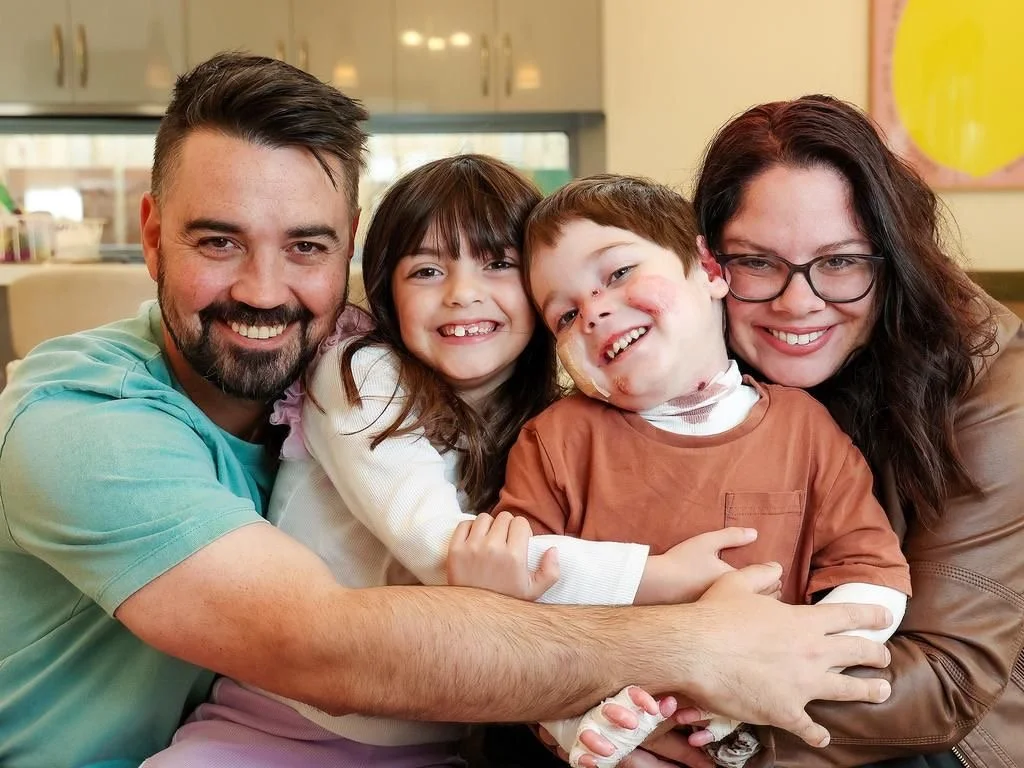
Nathan, Hannah, Jacob and Lauren Burmeister. Image courtesy of the Herald Sun.
“This is what years of work look like - finally, on a Tuesday morning, walking to kindy.”
Decades of science
B-VEC didn't appear from nowhere. It is the result of decades of EB research, much of it built on foundational work supported by EB Research Partnership's venture philanthropy model over more than a decade. EBRP has invested over $70 million globally, funded more than 160 research projects, and helped grow the number of EB clinical trials from just two to over fifty.
That work - patient, sustained, often invisible - is what made today's approved EB therapies possible. It is also what makes the next generation of treatments, across multiple EB subtypes, increasingly likely.
But scientific progress does not automatically reach patients. That requires a different kind of work.
Three years of advocacy
When the FDA approved B-VEC in 2023, Australian patients did not gain immediate access. Therapies approved overseas need to navigate the Therapeutic Goods Administration's regulatory pathways before becoming broadly available in Australia - a process that, for rare disease therapies, can take years.
EBRPA spent more than three years working on the access side. That work included direct engagement with government, including with then-Health Minister Greg Hunt. It included sustained pressure on industry to commit to a TGA filing pathway. It included philanthropic co-funding alongside the Royal Children's Hospital Foundation, and partnership with the RCH clinical team led by Associate Professor Tom Connell.
It also required the navigation of the TGA's Special Access Scheme - a critical but imperfect pathway that allows access to unapproved therapies on a case-by-case basis. The Special Access Scheme is not publicly funded. It is not scalable. It places the burden of access on families and philanthropic organisations rather than on the health system.
It is, currently, the only way an Australian child with RDEB can access B-VEC.
A milestone - and what it isn't
Jacob's treatment is a milestone for Australia. It demonstrates the clinical capability of RCH Melbourne. It validates the venture philanthropy model that has shaped EBRPA's work for more than a decade. And it offers tangible proof that, with sufficient effort, even the most complex rare disease therapies can reach Australian patients.
It is also, importantly, not a finish line.
B-VEC is approved for one EB subtype. There are multiple forms of EB, and the families of children with other subtypes - junctional EB, simplex EB, dystrophic EB outside Jacob's specific genetic profile - are still waiting for therapies that work for their children. EBRPA's research portfolio reflects this. We fund work across multiple subtypes and therapeutic approaches, including gene editing, cell therapies, protein replacement, and pain and itch research that benefits everyone living with EB regardless of subtype.
There are around 1,500 Australians living with EB. Most still cannot access the therapies that exist internationally. Two of the three FDA-approved EB treatments remain unavailable in Australia outside of Special Access arrangements.
That gap is not scientific. It is structural.
What comes next
A formal TGA filing for B-VEC is anticipated in the coming months. When that happens, EBRPA will advocate for the fastest available pathway to broader access - and will push for PBS consideration so that B-VEC, when approved, is determined by clinical need rather than by ability to pay.
Beyond B-VEC, the pipeline of emerging EB therapies is the strongest it has ever been. Australia's regulatory and access infrastructure will need to keep pace. EBRPA will continue to advocate for expanded and better-resourced TGA accelerated pathways for rare disease therapies, and for sustainable public funding mechanisms that reduce Australia's dependence on private philanthropy for access to proven treatments.
That's the work ahead. The science exists. The clinical capability exists. What needs to change is the system that determines whether - and how quickly - Australian patients reach the therapies that can change their lives.
Get involved
If this story matters to you - whether as a donor, a family affected by EB, an advocate, or a supporter who wants to be part of what comes next - there are several ways to engage:
• Share this story with your networks. Awareness is what unlocks policy.
• Get in touch about advocacy work, clinical trials, or patient access pathways. We'll point you in the right direction.
• Support EBRPA's work financially if you are in a position to do so. Every donation funds the research, advocacy, and access infrastructure that makes milestones like this possible.